A deadline five weeks away: the property tax exclusion ends 1 January 2027
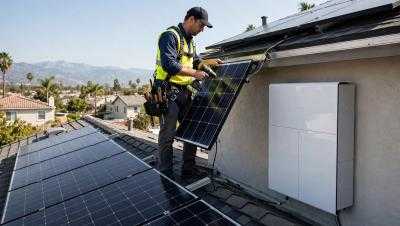
Everything else on this page matters less than this. Since 1999, California has kept solar out of the property tax base by a drafting trick: Revenue and Taxation Code section 73 says the term "newly constructed" in the state constitution "does not include the construction or addition of any active solar energy system." Build an array and your assessed value does not move. The exclusion covers more than panels: section 73(d)(1)(B) reaches "storage devices, power conditioning equipment, transfer equipment, and parts related to the functioning of those items," so a home battery is in.
Section 73 is now on a timer. As amended by SB 710 (Stats. 2025, Ch. 328), subdivision (i)(1) reads that the section "shall remain in effect only until January 1, 2027," and the Legislative Counsel's note on the code says the section is "Inoperative January 1, 2027, by its own provisions." Subdivision (g) limits it to lien dates through the 2025-26 fiscal year.
There is a grandfather clause, and it is narrow. Section 73(i)(2) provides that systems which "qualify for an exclusion under this section prior to January 1, 2027, shall continue to be excluded on and after January 1, 2027" -- but only "until there is a subsequent change in ownership." Subdivision (f) says the same thing in general terms. So the exclusion is not attached to the house forever. It is attached to the house until you sell it.
For a homeowner weighing a 2027 installation against a 2026 one, that is the whole question. Qualify before 1 January 2027 and your solar is outside your assessed value for as long as you own the home. Qualify after, and on current law there is no exclusion at all. Note also what section 73(b)(2) leaves out: solar swimming pool and hot tub heaters never qualified.
Net metering is closed. What replaced it pays much less
The older version of this page told readers they could "net-meter with their local utility." That is no longer available to anyone starting now. The CPUC states that the NEM tariffs "are closed to new enrollments," and that "Since April 15, 2023, customers applying for interconnection have taken service on the new net billing tariff (NBT) pursuant to D.22-12-056." Southern California Edison puts the dates plainly: "NEM 1.0 closed to new customers in 2017," and "On April 15, 2023, NEM 2.0 closed to new customers and the Solar Billing Plan went into effect."
The difference is not a detail. Under net metering, the CPUC says, bill credits were "applied to customers' monthly bills at the retail rates (including generation, distribution, and transmission components)." Under the net billing tariff, compensation for exports is "applied to a customer's bill at a rate reflecting the value of this generation to the grid." In the Legislature's own description of Decision 22-12-056, those are "retail export compensation rates based on hourly avoided cost calculator values averaged across days in a month," softened for early adopters by "an avoided cost calculator plus adder, based on cents per kilowatt-hour exported, available during the first 5 years of the successor tariff," known as the glide path.
The practical consequence is that a California system designed to export is now designed wrong. When a kilowatt-hour sent to the grid earns a fraction of what a kilowatt-hour drawn from it costs, the value moves to using your own generation on site, which is why batteries have gone from optional to central in California proposals. Ask any installer to model your bill under the net billing tariff specifically, with the export rates for your utility, and to show you the result with and without storage.
If you already have solar, or you are buying a house that does
Existing customers were not swept up in the change. Decision 22-12-056 "did not affect customers who submitted a NEM interconnection application by April 14, 2023." Edison describes the legacy term as 20 years and is specific about when the clock starts: "The eligibility period begins on the account's PTO date" -- permission to operate, not contract signature, not installation. At the end of the term "the account will automatically move to the Solar Billing Plan or the successor rate plan." Customers who came in on virtual net metering or NEM aggregation after 14 April 2023 get "a minimum of 9 years" instead.
Buying a home with existing solar is the unresolved case, and it is worth understanding why. No utility page we could find states whether a legacy tariff passes to a new owner. In 2025 the Legislature tried to settle it in the other direction: Assembly Bill 942 would have added Public Utilities Code section 2827.2 requiring anyone who "becomes a new eligible customer-generator by purchasing real property that contains a renewable electrical generation facility" to move to the current tariff, lose the glide path adder, and pay all nonbypassable charges.
That section was struck by the Senate amendment of 17 July 2025. What survives in AB 942 is unrelated: an amendment to section 748.5 denying the California Climate Credit to a residential customer who is not on CARE or FERA and "whose total annual electricity bills from the previous year is less than three hundred dollars ($300)." But the bill has not died either. It sits in Senate Rules, its last committee action dated 29 August 2025, and a bill in committee can be amended again. If you are buying a solar home, get the tariff, the PTO date and the remaining legacy term in writing before closing, and treat the transfer question as open.
| Tariff | Closed to new customers | Export credit | Legacy term |
| NEM 1.0 | 2017 | Full retail rate | 20 years from PTO |
| NEM 2.0 | 15 April 2023 | Full retail rate, less non-bypassable charges | 20 years from PTO |
| Net billing tariff (NBT) | Open | Avoided cost value, plus glide path adder for the first five years | n/a |
| Virtual NBT and aggregation | Open (from 15 February 2024) | As NBT | n/a |
The rebate the old text promised no longer exists
This page used to tell Californians they would "get reimbursed for a chunk of the cost of purchase and installation through the California Solar Initiative." They will not. Per the CPUC, the CSI general market rebate stopped accepting new applications in 2016 and the program's components were fully wound down by 2021. The Commission's reasoning at the time was that equipment prices had fallen far enough that direct per-watt incentives were no longer needed. The surviving listings under the CSI name on this site are for solar water heating, not photovoltaics.
The federal residential credit is gone too. The Residential Clean Energy Credit under Internal Revenue Code section 25D ended for expenditures made after 31 December 2025, and the IRS has said that paying before the deadline did not preserve the credit if the installation was finished afterward.
What the state is actually committed to
The old text cited a standard requiring "50 percent of their electric generation from renewable resources by 2030." The operative policy is now in Public Utilities Code section 454.53, as amended in 2024, and it is considerably more ambitious: renewable and zero-carbon resources are to supply "90 percent of all retail sales of electricity to California end-use customers by December 31, 2035, 95 percent ... by December 31, 2040, 100 percent ... by December 31, 2045," plus all electricity procured for state agencies by 2035. The separate Renewables Portfolio Standard continues to bind load-serving entities under Article 16 of the Public Utilities Code.
What is still worth having
California's remaining advantages are structural rather than cash. The Solar Rights Act limits what a homeowners association can do to block an installation, and the Solar Easement and Solar Shade Control Act protects an existing array from being shaded by a neighbor's later planting. Interconnection standards set the process your utility must follow. Municipal utility customers sit outside the CPUC's tariffs entirely -- LADWP, for one, runs its own net metering program, and if you are served by a city utility its rules, not the net billing tariff, govern your exports.
The full list of California programs below this summary carries the municipal rebates, PACE financing districts and local requirements, several of which pay more in a single city than anything available statewide. Two things are worth confirming directly rather than taking from any website: the current export rates for your own utility, and whether your installation can be complete and qualified before 1 January 2027.