
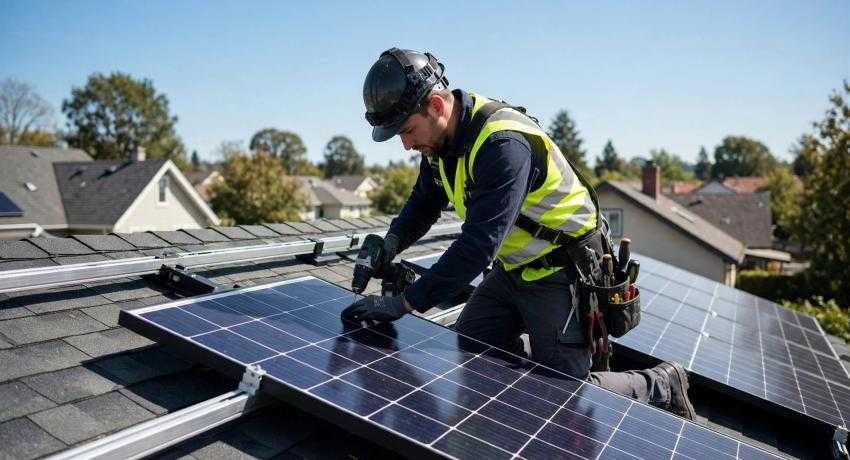
Two neighbours can use the same sun and end up with two very different solar setups. One subscribes to a share of a solar farm and sees a credit on the electric bill. The other has panels on the roof, owns them, and watches the meter run backwards. Both are solar. Neither is the right answer for everyone.
This guide compares the two routes in plain English: community solar, where you subscribe to a share of an off-site project, and owning your own rooftop system. If you want a price for a rooftop system sized to your home, get a solar quote — an installer will confirm the numbers against your roof and your utility's rules.
What community solar actually is
Community solar is a shared solar project. A solar farm is built off-site, its electricity goes into the grid, and you subscribe to a share of it. Your utility credits your bill for your share of the power produced, and you pay the provider a subscription fee. Your saving, if there is one, is the gap between the credit and the fee.
The U.S. Department of Energy notes that, according to National Renewable Energy Laboratory analysis, nearly half of households and businesses are unable to host rooftop solar — because they rent, their roof is shaded or too small, or they cannot afford the upfront cost.
With a subscription there are no panels, no installation, no permits, and no maintenance to arrange. In many programs there is no upfront cost, and you can move your subscription within the same utility area or cancel with notice. "Many" is not "all" — the contract is where that promise lives or dies.
Community solar is not available everywhere. The Department of Energy counts more than 1,600 projects across 39 states and the District of Columbia, but 72% are in only four states — Minnesota, Florida, Massachusetts, and New York. If no project serves your utility area, there is no subscription to buy.
What owning your own rooftop solar actually is
Owning a rooftop system means panels on your roof that you own — bought with cash or a loan. You use what you generate, and the surplus goes back to the grid. What you earn for it depends on your utility: some credit exports at the full retail rate, some pay a lower avoided-cost rate, and some use net billing. Those rules vary by utility and can matter as much as the panels, so check your electric utility's export and interconnection rules before you sign.
The trade-off is the upfront cost and the commitment. A rooftop system needs a suitable roof in decent condition, with enough sun and space, plus permits, an installer, and an interconnection agreement. You own the maintenance, and the system stays with the house when you move.
On home value, the evidence points one way but not to a fixed number. An older Lawrence Berkeley National Laboratory study (home sales, 2002–2013) found buyers paid about $4 per watt for homes with owner-owned solar — roughly $15,000 for the average 3.6 kW system then. That is old data, and Berkeley Lab has cautioned premiums are likely smaller now, so treat it as evidence buyers have valued owned solar, not as a figure to add to a listing price.
A third route sits between the two: a solar lease or power purchase agreement (PPA). A third party owns the panels on your roof, you pay a monthly lease or a per-kilowatt-hour rate, and the upfront cost is low or nothing. The catch is the same as with community solar — you do not own the system, so you do not keep the full value of what it generates — and a lease or PPA can complicate a home sale, because the buyer has to take over the contract.
The federal picture has also changed: the 30% Residential Clean Energy Credit (Section 25D) does not apply to expenditures after December 31, 2025, so a system you buy in 2026 gets no 25D credit. Do not plan around it.
How the savings actually work
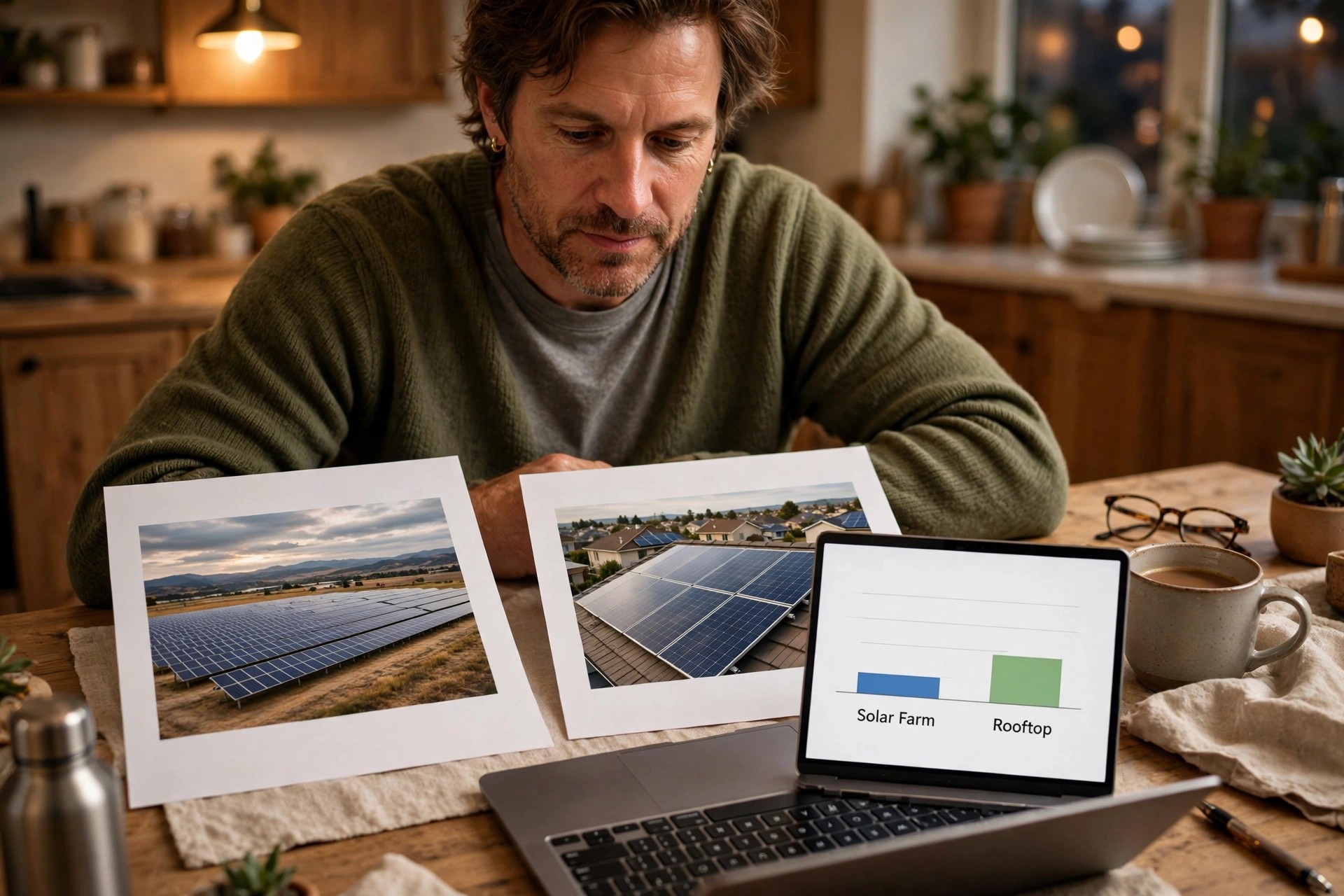
Community solar: you save only when the bill credit is worth more than the subscription fee, month after month. A DOE study, as reported by Colorado Public Radio in 2024, found community solar can cut household electricity costs by roughly 5–15%. Treat that as a reported range, not a promise. The Department of Energy's consumer-protection guidance recommends at least 20% household savings with no sign-up, exit or termination fees — a recommendation, not a guarantee that every offer meets it.
Owned rooftop solar: you save by buying less electricity from the grid, plus whatever you earn for exported surplus. Once the system has paid for itself, you keep the full value of what it generates, which is why a well-sited owned system can deliver larger lifetime savings than a subscription. But payback is slower now that the federal credit is gone, and it depends on your rate, usage, roof, and export rules.
Illustrative example. Suppose your share earns a $100 bill credit and your fee is $90. Your saving is $10. If the fee were a fixed $90 in a cloudy month when the credit was only $60, you would pay $30 more than the credit was worth. These are examples, not quotes.
Neither route keeps your lights on in an outage on its own. Community solar credits touch your bill, not your home's wiring. A standard grid-tied rooftop system also shuts off during an outage unless it is paired with a battery. If backup power is the reason you want solar, that is a battery question.
Who each one suits
Community solar is usually the practical choice if you rent, live in an apartment or condo, or do not control the roof; if your roof is shaded, faces the wrong way, is too small, or needs replacing soon; if your homeowners association or building rules block rooftop panels; if you cannot afford, or do not want, a large upfront cost or a loan; or if you may move soon — provided your subscription can move with you or be cancelled without a painful fee.
Owning a rooftop system is usually the stronger choice if you own your home and plan to stay for years; if your roof is in good condition, gets good sun and has room; if you can pay cash or take a loan and want the largest long-term saving; if you want to pair solar with a battery for backup power, or with an EV charger behind the same meter.
If neither fits — no community program serves your address and your roof will not take panels — there is a third, much smaller option. Plug-in solar kits are small, portable kits that plug into a standard outlet. They will not replace a rooftop system or a community subscription, but for renters they can trim the always-on baseline load.
What to check before you sign — either route
For a community solar subscription, get these answers in writing: the contract length and cancellation terms — cancellation often requires 30 to 90 days' notice, sometimes with a fee; whether your fee is a fixed percentage of the credit value or a fixed monthly amount; whether the fee rises each year, and what it will be in year five and year ten; whether your share is credited at the retail rate or a lower avoided-cost rate; what happens if you move or use less power; and whether the saving is guaranteed — and where that promise is written.
For a rooftop system, the checks are different: the age and condition of your roof, shading through the year, your utility's export and net metering rules, and whether you are buying, borrowing, leasing or signing a PPA — and, for a lease or PPA, the escalator, the term, and what happens when you sell the house. Incentives vary widely by state and utility — check the solar rebates and incentives directory for your area before budgeting, and confirm any program figure with the program itself.
Checklist
- Check whether a community solar project serves your utility area — if not, that option is closed.
- For community solar, get the discount, fee structure, escalator, contract length, and cancellation terms in writing.
- Confirm the credit rate — retail or avoided cost — and whether the saving is guaranteed.
- For rooftop solar, check your roof's age, condition, shading, and sun first.
- Confirm your utility's export and net metering rules before you sign anything.
- Price rooftop solar on what exists today — no 30% credit for 2026 installs.
- Compare lease and PPA offers on total cost over the full term, not the first monthly payment.
- Ask what happens if you move — for a subscription, and for a rooftop system.
- Do not sign a contract promising a fixed saving without showing where that promise is written.
Bottom line: Community solar is the way in if you cannot put panels on your own roof — no upfront cost, no installation, and a modest monthly saving when the credit beats the fee. Owning a rooftop system costs more upfront, but a well-sited owned system can save more over its lifetime, because you keep the full value of what it generates. Choose the option that fits your home, your roof, and how long you plan to stay — not the one with the biggest headline discount.
This is general information, not financial advice. Savings depend on your state, utility, roof, and contract — get competing quotes in writing and check current program terms before you decide.